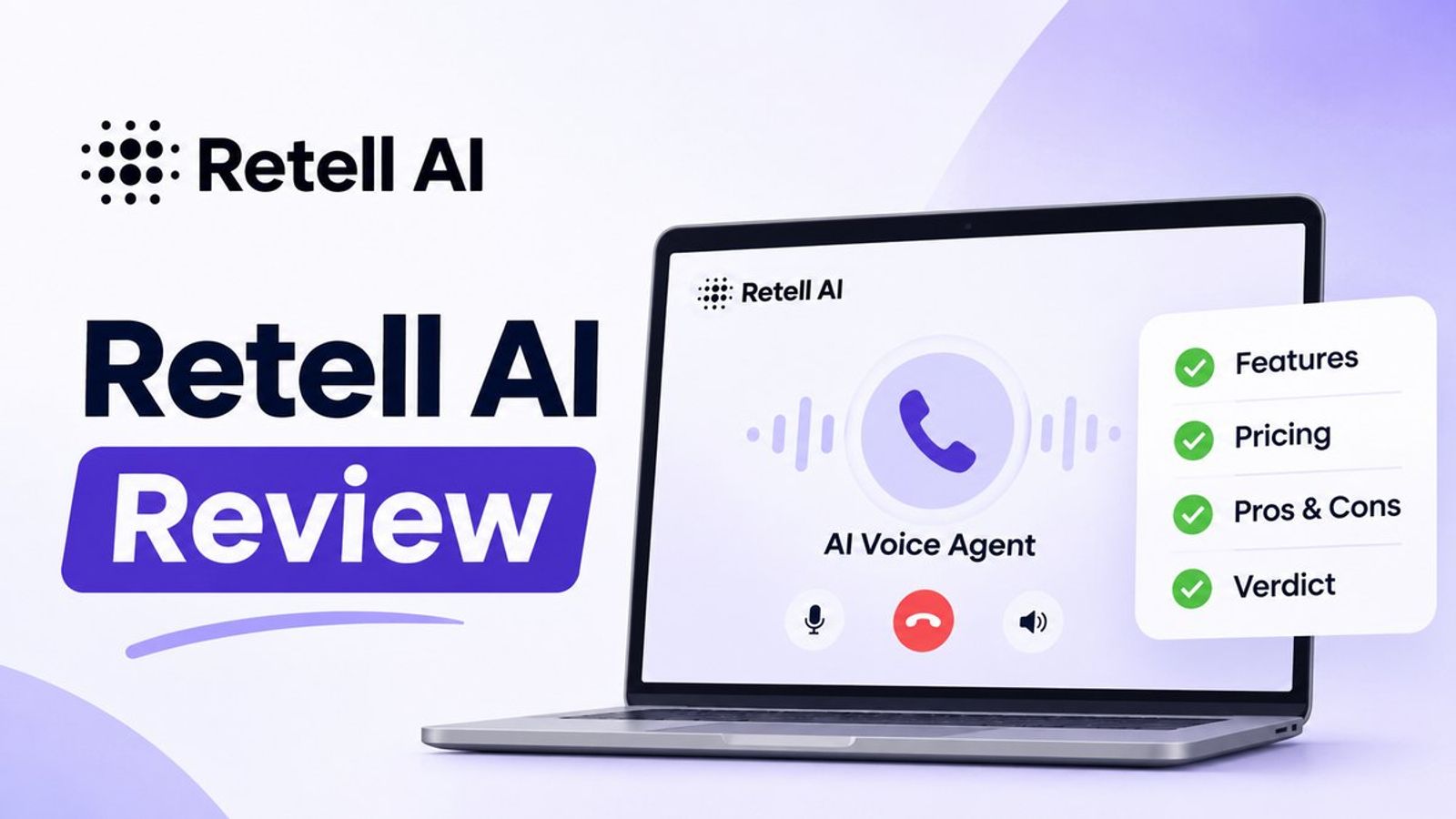
This Retell AI review looks at what it takes to put an AI voice agent on a business phone line. Retell gives teams one place to configure the agent, connect a number, test conversations, and inspect calls. The buying decision comes down to how well it handles your carrier, your callers, and the cases your staff needs to take over.
Retell is worth piloting for a narrow workflow such as after-hours intake or appointment requests. Evaluate it on completed tasks, successful transfers, and cost per outcome. This review draws on Retell's public documentation and pricing as of November 12, 2026.
Retell AI Review and Who It Fits
Retell supports agents that answer inbound calls or place outbound ones. Teams can configure conversation instructions and flows, attach a knowledge base, and let the agent call tools during a conversation. A caller can ask when a location closes, for example, then move on to a scheduling request that needs current availability from a separate system.
Pick one job for the first agent. A property maintenance line could collect an address, check whether it is in the service area, and route urgent cases to an on-call team. Define what counts as urgent and where those calls go before writing the greeting. For teams comparing a dedicated phone agent with a broader customer service platform, SD's Salesforce Agentforce review covers the tradeoffs of building around an existing service stack.
Retell sells managed US and Canadian numbers and documents custom telephony through SIP. Managed numbers are an option for a small pilot. If you already have business numbers and queues, verify that your provider can route calls and preserve the caller information your staff needs. Include workspace verification in the timeline if you plan to buy a number or use outbound calling.
How Retell AI Call Transfers Work
A cold transfer sends the caller to the destination and the original AI agent drops off. A warm transfer can wait for someone to answer and brief them before connecting the caller. Retell also documents an agentic warm transfer in which a second AI agent speaks with the destination and decides whether to connect the call. For a simple department directory, the cold option may be sufficient. For a customer who already explained a complicated issue, a short briefing can spare them from starting over.
Keep the briefing short enough for a busy rep to use. For a maintenance call it might include the caller's confirmed address, the reported issue, and whether anyone is on site. Leave speculative diagnoses out. If a handoff cannot complete, the next step should be something the caller can verify, such as a callback request with a clear expectation about timing.
Carrier behavior can change the result. Retell's transfer documentation says that forwarding the original caller ID depends on provider support and that an unsupported override can cause a transfer to fail. Try the same route with an available rep, a busy line, and voicemail. Define an acceptable outcome for each, such as a callback request with a confirmed phone number. Have someone check what the receiving rep sees and hears.
Connect Call Events to Your Workflow
A booking tool should tell the agent whether an appointment was actually written. Test an expired slot, a timeout, and a repeated request. Have the agent confirm only after the booking system returns success, and make the write safe to retry so one call cannot create multiple appointments.
Retell exposes webhook events for call start, call end, and completed analysis. Use the event that carries the data you need. For a callback queue driven by post-call analysis, use the completed-analysis event, verify the webhook signature, and deduplicate by call ID and event type. SD's n8n review covers how workflow hosting and execution affect the integration you would maintain after a call ends.
Retell AI Pricing and What Changes the Bill
Retell advertises $0.07 to $0.31 per minute for pay-as-you-go voice agents, with $10 in trial credits for eligible new accounts. Its detailed pricing lists components for voice infrastructure, the model, speech synthesis, telephony, and optional features. Some speech-to-speech model entries exceed the headline range. Price your exact configuration and include the carrier bill when you bring your own telephony.
Suppose a pilot handles 1,000 connected calls averaging three billable AI minutes. At an assumed effective voice rate of $0.12 per minute, that is $360 in usage. Add any fixed fees, test usage, and carrier charges outside that assumption. Silence or hold time while the agent is active can count. Retell says AI voice fees stop after a completed handoff, while telephony charges can continue. Agentic warm transfer can also incur usage for its separate transfer agent.
Measure peak simultaneous calls alongside monthly minutes. Retell lists 20 included concurrent calls on pay-as-you-go, and its billing guide says usage stops when a prepaid balance reaches zero. Set up a way to monitor balance and recharge failures if customers rely on the line. Compare total spending against tasks confirmed in the system of record. That makes repeated calls and failed bookings visible in the economics of the pilot.
Compare two configurations before you settle on a model and voice. Run each through the same short information calls and longer booking calls. A cheaper model can lose its apparent advantage if it takes extra turns to collect the same information. A more expensive configuration needs to earn its cost through better outcomes on the calls you actually receive.
Test the Phone Line Before Expanding
Use text simulations for decision logic and tool routing where the agent type supports them. Use a browser call to hear pacing, pronunciation, and how the agent reacts when interrupted. Then dial the actual test number to check keypad input, carrier audio, voicemail, and transfers. Retell's documentation says custom LLM and speech-to-speech agents need audio testing. Its testing pricing also distinguishes per-message text tests from per-minute voice tests, so include regression runs in the pilot budget.
Test with callers who say an address quickly, change their mind midway through a booking, or ask for a human twice. Record how often the task completes, how long the slowest replies take, and how often a transfer reaches the intended person. Look at slow calls individually. A delay could come from a calendar lookup, a long pause after the caller stops speaking, or the receiving phone queue.
Before expanding, pick a test route you can divert back to your usual queue and check that the diversion works. During the pilot, reconcile a sample of Retell call records with the destination queue and booking system. A call marked complete can still contain a mistaken time or a transfer to the wrong desk. Keep the failures as test cases for the next change to the prompt or routing.
Data Controls and Alternatives
Retell offers per-agent storage and retention settings. Its documentation says webhooks can still expose sensitive call artifacts after storage is limited, so inspect what your webhook handler logs and what your CRM retains. Keep tools scoped to the action the caller needs. A status lookup can use a read-only credential, while a booking tool can accept only eligible locations and slots. SD's AI agent security guide explains how to constrain tool permissions and review what an agent can access.
When comparing Retell AI alternatives such as Vapi or a phone system's built-in routing, run the same small set of calls. Compare caller ID, transfer success, booking correctness, and the cost of keeping the integration healthy. A simple keypad menu may be enough when callers mainly need to reach the right department. Retell earns a closer look when understanding a spoken request and acting on it would save work on both ends of the line.
Conclusion
This Retell AI review finds the clearest fit in a focused inbound workflow with a reliable human fallback. Start with a single queue, price the actual configuration, and make real test calls through the carrier and destinations you plan to use. Expand when completed tasks, successful handoffs, and cost per outcome meet the targets your team set for the pilot.
Written by
Lena Ortiz
AI Tools Analyst
Lena tests AI products through the lens of creators, operators, and teams that need software to stay useful after launch week.
FAQ
Is Retell AI free to try?
Retell lists $10 in trial credits for eligible new accounts. Testing uses billable rates, and recurring charges can apply to items such as managed phone numbers or extra concurrency.
Can Retell AI use an existing phone number?
Retell supports connecting custom telephony through SIP. Check your provider's routing, caller ID, and transfer support before moving traffic from an existing business number.
Can Retell AI transfer callers to a human?
Yes. Retell documents cold, warm, and agentic warm transfers. Test the exact route with a real call, including what happens when the intended recipient is busy or unavailable.